
Machine Information & Equipment Context
The first and most foundational piece of information to communicate is your exact machine name and model number. A knife manufacturer uses this to understand the mechanical context — rotational speed, feed rate, clamping method, and dimensional tolerances inherent to that platform. Without this, even a geometrically identical blade may fail in practice due to unaccounted operational stresses.
If you are sourcing knives for a proprietary or modified machine, provide a brief operational description: cutting type (rotary, guillotine, slitting), material throughput speed, and the environment (wet, dusty, high-temperature). The more context you provide, the more precisely Huaxin Carbide can engineer a solution optimized for your conditions — not a generic approximation.
Technical Drawings & Dimensional Specifications
A dimensioned drawing or engineering sketch is the single most valuable document you can supply. It conveys what words cannot — the spatial relationship between mounting holes, cutting edges, bevels, and profile geometry. Even a hand-drawn sketch with annotated measurements dramatically reduces the risk of manufacturing errors on custom industrial blades.
Accurate hole specifications are particularly important: incorrect hole diameter or pitch will prevent secure fastening and introduce vibration that accelerates edge wear. If you are replacing existing blades, measure the worn knife directly rather than relying on older documentation — blades often deviate from original specs through previous re-grinds.
Bevel Type & Cutting Edge Geometry
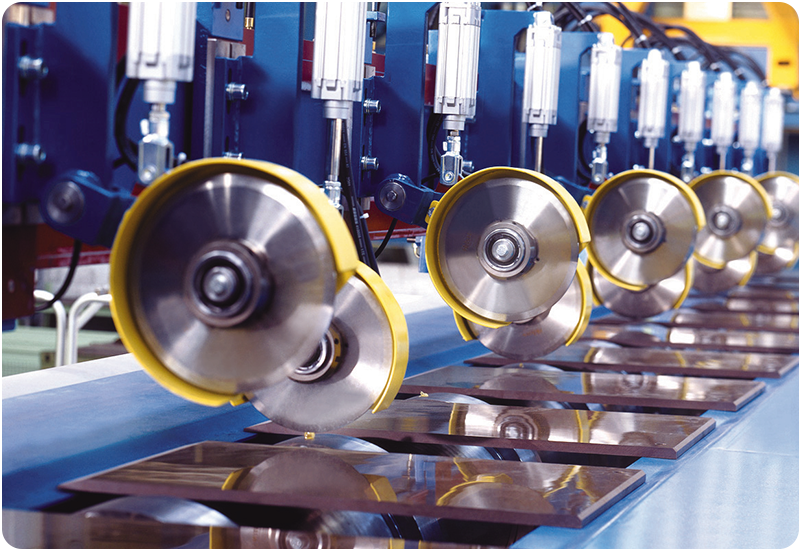
The cutting edge geometry is arguably the most application-sensitive variable in knife specification. Bevel type determines how force is distributed at the point of contact, while bevel angle governs the balance between sharpness and edge durability. Selecting the wrong geometry often explains why a knife that looks dimensionally correct still underperforms.
| Angle Range | Recommended For | Trade-off |
|---|---|---|
| Low angle (15–25°) | Soft materials: foam, rubber, textiles, thin film | Maximum sharpness; edge more susceptible to chipping |
| Medium angle (25–35°) | Paper, cardboard, laminates, plastics | Balanced sharpness and durability |
| High angle (35°+) | Hard materials: rigid plastics, composites, metal foil | Superior edge life; marginally reduced initial sharpness |
At Huaxin Carbide, our applications engineers collaborate with you to determine the optimal bevel configuration — combining edge geometry with material selection and surface treatment to deliver a blade that remains sharp under production conditions, not just in isolation.
Blade Materials & Surface Engineering
Material selection directly governs wear resistance, corrosion behaviour, and the total cost of ownership of your cutting tool. Huaxin Carbide offers a curated portfolio of industrial-grade materials, each suited to specific cutting environments and material types.
Surface treatments extend blade performance beyond what material choice alone can achieve:
Mirror polishing reduces surface friction at the cutting interface, minimising material adhesion when slitting sticky films, adhesive laminates, or dust-generating substrates. It also removes micro-surface oxidation, preserving the edge profile over a longer service cycle.
Functional coatings — including ceramic, titanium nitride (TiN), and diamond-like carbon (DLC) — provide an additional barrier against corrosion, chemical attack, and abrasive wear. For the highest-performance cutting environments, Huaxin Carbide recommends combining mirror polishing with an appropriate edge coating for compounded protective benefits.
Quantity, Lead Time & Performance Feedback
Communicating your required quantity and delivery window allows Huaxin Carbide to align production scheduling with your operational needs — whether you require a small prototype batch for validation or a high-volume production run with scheduled replenishment intervals.
Beyond specifications and quantities, one of the most valuable inputs you can provide is performance feedback from your current knives: What is failing prematurely? Are edges chipping, dulling too quickly, or leaving a rough cut surface? Is corrosion or adhesion a recurring problem? This diagnostic information enables our engineers to make targeted improvements — rather than simply replicating an existing design’s limitations. At Huaxin Carbide, we view every custom order as an engineering collaboration, not a simple transaction.
Ready to Specify Your Custom Industrial Knife?
Huaxin Carbide has engineered precision cutting solutions for global industries for over 98 years.
Contact our technical team with your specifications — we’ll engineer the right blade for your application.
Post time: May-25-2026


