
On a filter maker running at full speed, a cutting knife has no time to compensate for its own imperfections. Each rod has to come off at the same length as the one before it and the one after it, thousands of times a minute, with no operator watching closely enough to catch a knife that’s drifted a few microns out of tolerance. By the time anyone notices, the machine has already produced a run of filters that don’t quite match spec.
Why Tolerance Becomes the Whole Story at This Scale
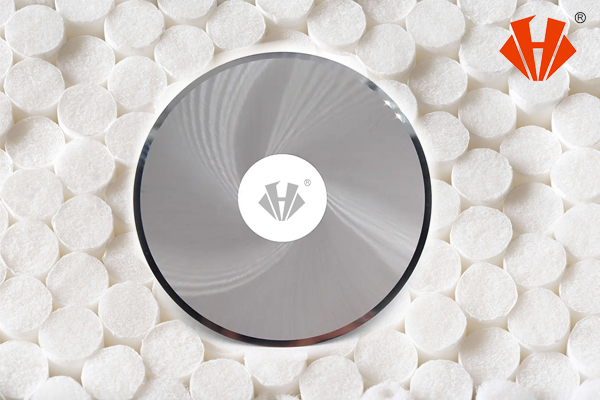
Filter and tipping knives don’t get judged on hardness alone. A blade can be hard enough to survive a long production run and still cause problems if its diameter, thickness, or edge geometry isn’t held to a tight enough tolerance from the start. At filter-cutting speeds, even a deviation too small to see with the naked eye shows up downstream — in rod length consistency, in how cleanly the tipping paper bonds, in how evenly the finished filter feeds into the next station. The knife isn’t just cutting; it’s setting a dimension that the rest of the line has to trust without double-checking.
Where Precision Is Actually Measured
Tolerance isn’t a single number on a spec sheet — it’s a set of related measurements that all have to hold together at once.
| Tolerance Parameter | What It Controls |
|---|---|
| Outer Diameter | Determines rotational fit against the mating knife or anvil; drift here changes cut position over time. |
| Bore / Inner Diameter | Governs how true the blade runs on its shaft — a loose or tight bore shows up as vibration at speed. |
| Thickness & Flatness | Uneven thickness translates directly into inconsistent rod length and uneven cutting force across the edge. |
| Concentricity / Runout | Even a well-made blade will cut unevenly if it isn’t centered true to its rotational axis. |
| Edge Angle & Sharpness | Controls cut cleanliness — a shifting edge angle is often the first sign of an underlying grinding inconsistency. |
Each parameter is manufactured and verified individually, but it’s the combination that determines whether a blade performs consistently on the machine.
What Holds These Tolerances Together in Production
A blade that measures within spec on day one and drifts by day thirty hasn’t really solved the tolerance problem. Consistency over the life of the blade comes down to four things happening in sequence during manufacturing.
Sub-micron and ultra-fine grain grades are chosen to hold an edge without becoming brittle under the repeated impact of high-speed cutting.
Outer diameter, bore, and thickness are ground to micron-level targets on equipment built for repeatability, not just a single accurate part.
The cutting edge is finished and the blade dynamically balanced so it runs true at production speed instead of introducing vibration of its own.
Every parameter is measured against spec before the blade ships, so tolerance is confirmed rather than assumed.
Huaxin’s Approach to Thin-Film Carbide Blades
Huaxin Cemented Carbide Co. focuses on advanced materials and manufacturing processes to produce blades that excel in hardness, wear resistance, and sharpness. That focus on thin-film carbide precision — built for applications where a few microns make the difference between a blade that performs and one that doesn’t — has made Huaxin a trusted partner for businesses across the tobacco industry that need filter and tipping knives manufactured to tight, repeatable tolerances.
Sub-micron grades selected for the hardness-to-toughness balance that high-speed filter cutting demands.
CNC precision grinding holds outer diameter, bore, and thickness within tight, repeatable tolerance across full production batches.
Edge angle and sharpness are held steady from blade to blade, not just on the sample piece.
Dimensions and tolerance classes manufactured to customer drawings or samples for specific filter maker models.
One Part of a Broader Thin-Film Carbide Capability
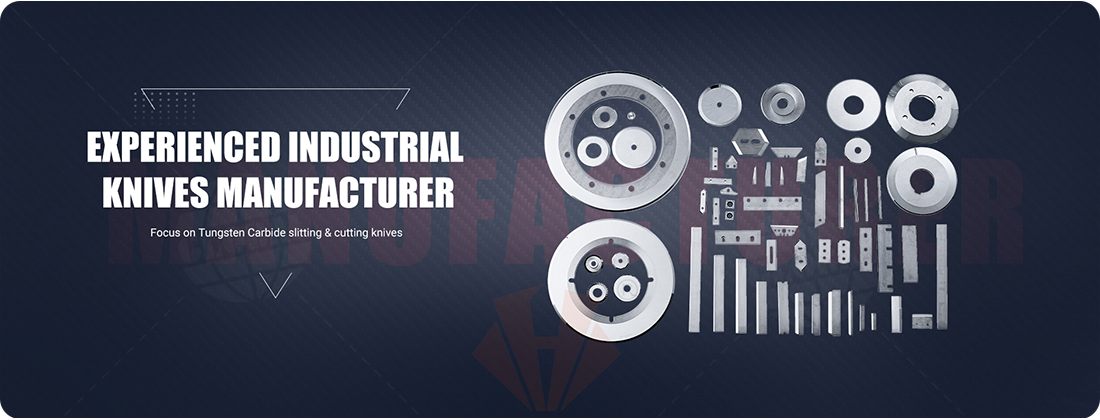
Tobacco filter and tipping knives are one piece of a wider thin-film carbide blade capability at Huaxin, which extends to staple fiber cutting blades, slitting knives, and precision industrial blades for other high-speed cutting applications. The same emphasis on hardness, wear resistance, and dimensional consistency that goes into a filter knife carries across every product line — the specifics of the tolerance change by application, but the manufacturing discipline behind them doesn’t.
Need Filter or Tipping Knives Held to Tighter Tolerance?
Huaxin manufactures thin-film carbide blades for the tobacco industry to customer drawings or samples, with tolerance classes built for high-speed filter and tipping applications.
Post time: Jul-18-2026


