
On the sintering floor in Chengdu, a technician watches a furnace readout climb past 1,400°C, waiting for a batch of grey-black powder to become something else entirely. What goes in is fine tungsten carbide grain bound with cobalt; what comes out, hours later, is a blank hard enough to outlast the steel it will eventually cut through. Getting from one state to the other — reliably, at scale, within microns of tolerance — is the entire story of how a Mark IV or Mark V blade earns its name.
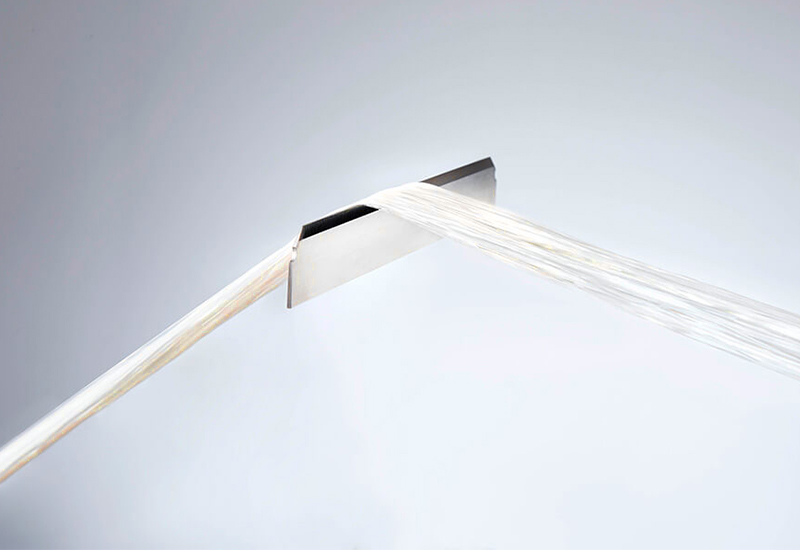
Huaxin Cemented Carbide Co., Ltd builds that story around two things: the materials chosen before a blade ever touches a machine, and the sequence of pressing, sintering, grinding, and honing that follows. The result is a line of thin-film carbide blades trusted by manufacturers who cannot afford an edge that dulls mid-shift — whether they’re slitting corrugated board, cutting staple fiber, or shearing lithium battery separator film.
Every Mark-series blade is decided long before it reaches a grinder. Huaxin selects tungsten carbide grain size and cobalt binder ratio to match how the blade will actually be used — a finer grain and lower cobalt content for blades that need maximum hardness and edge sharpness, a slightly coarser grain and higher binder content where impact resistance matters more than raw hardness. Mark IV formulations lean toward the balanced middle of that spectrum, built for general-purpose durability across a wide range of cutting applications. Mark V pushes further toward ultra-fine grain structures, trading a little impact tolerance for noticeably longer edge retention and a cleaner cut on demanding materials.
The transformation happens in five stages, each one correcting for what the last stage couldn’t control.
Tungsten carbide grain, cobalt binder, and grain-growth inhibitors are wet-milled together for uniform particle distribution — the single biggest predictor of consistent hardness across a batch.
The blended powder is compacted into a green blank under high uniaxial pressure, close to final blade geometry but still fragile enough to handle carefully.
Blanks are fired in a vacuum or sinter-HIP furnace above 1,400°C, where the cobalt binder liquefies and pulls the carbide grains into a dense, near-zero-porosity structure.
Diamond wheel grinding brings the blade to final thickness and flatness, holding tolerances tight enough that Mark V blades vary by no more than a couple of microns across a batch.
The cutting edge is honed to its final bevel angle, then optionally coated — TiN, TiAlN, or DLC — to reduce friction and add a further layer of wear resistance for high-cycle applications.
Every blade is checked for hardness (Rockwell A), edge geometry, and surface finish before it’s cleared to ship — the last gate between the furnace and the customer’s machine.
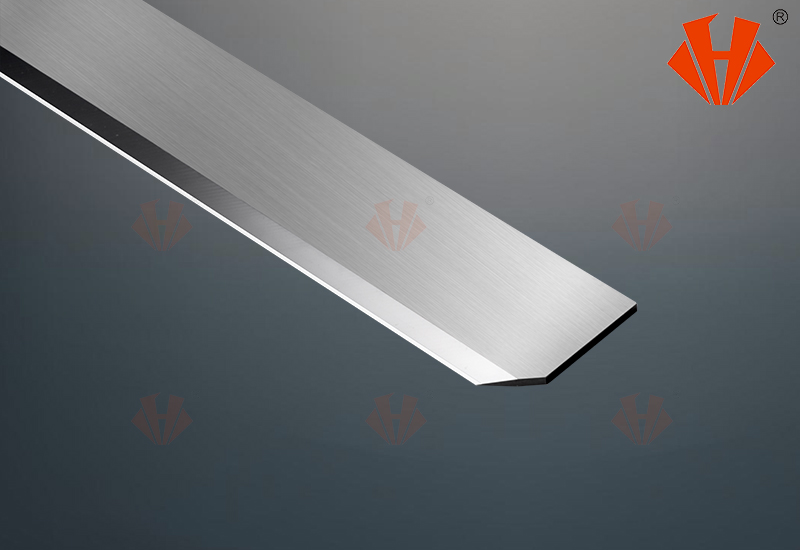
The two lines share a manufacturing backbone, but the differences show up exactly where users feel them — at the edge, and over time.
| Specification | Mark IV | Mark V Latest |
|---|---|---|
| Grain structure | Standard fine | Ultra-fine, sub-micron |
| Hardness (HRA) | 90–91.5 | 92–93 |
| Edge tolerance | ±5μm | ±2μm |
| Recommended coating | TiN standard | TiAlN / DLC options |
| Best suited for | General-purpose, mixed-material lines | High-cycle, abrasive, or fine-tolerance cutting |
| Typical edge life | Baseline | ~30–40% longer than Mark IV |
“The manufacturing gate that matters most isn’t pressing or sintering — it’s the inspection step nobody sees. That’s where a good blade becomes a Mark V blade.”
— Huaxin Process Engineering Team
A Corrugated Board Line Cuts Its Blade Changeovers by Nearly Half
A mid-size packaging manufacturer running triple-shift corrugated slitting was replacing standard steel blades every few days, each swap costing line downtime and scrap. Switching to Mark V blades with a TiAlN coating extended service intervals significantly, holding edge geometry through far more linear feet of board before requiring a swap.
The same core process — powder selection, pressing, sintering, precision grinding, and edge honing — underpins Huaxin’s blade lines across a wide set of industrial verticals, tuned in grain size, binder ratio, and coating for each.
What’s the practical difference between Mark IV and Mark V blades?
Mark V uses a finer carbide grain structure and tighter grinding tolerances, which translates to higher hardness and longer edge retention. Mark IV remains a strong, cost-effective choice for general-purpose or mixed-material cutting where ultra-fine tolerances aren’t the priority.
Why does sintering temperature matter so much?
Sintering is where the cobalt binder liquefies and densifies the carbide structure. Too low a temperature leaves porosity that weakens the blade; too high can cause abnormal grain growth. Precise furnace control is what makes hardness consistent from batch to batch.
Does coating choice actually affect blade life?
Yes. A TiAlN or DLC coating reduces friction and adds a hard, thin surface layer, which can meaningfully extend service life in high-cycle or abrasive cutting environments compared to an uncoated or standard TiN-coated edge.
Can Huaxin customize grain size or coating for a specific application?
Yes — grain size, cobalt ratio, edge geometry, and coating are all adjustable based on the material being cut and the duty cycle of the line. Huaxin’s engineering team works directly with customers to match blade specification to application.
Need a Blade Spec’d to Your Line?
Huaxin Cemented Carbide Co., Ltd designs Mark IV and Mark V blades around your material, your cycle time, and your tolerance requirements.
Or call +86-181-0906-2158 — Huaxin Cemented Carbide Co., Ltd, Chengdu
Post time: Jul-23-2026


