
In staple fiber cutting, blade performance is defined by one word: hardness. But hardness does not come from material selection alone. It is the result of how the material is processed, especially through heat treatment. Understanding this process helps manufacturers choose the right blade for consistent cutting quality, longer service life, and stable production.
Why Heat Treatment Matters in Staple Fiber Cutting
Staple fiber blades operate under demanding conditions. They cut high-speed fiber bundles, often containing abrasive additives or recycled content. During operation, blades are exposed to:
1. Continuous friction
2. Localized heat at the cutting edge
3. Repeated mechanical impact
Without proper heat treatment, even a high-quality material will fail prematurely—either through rapid edge wear, deformation, or chipping.Heat treatment controls the microstructure of the blade material. This directly affects hardness, toughness, and wear resistance, which together determine cutting performance.

Heat-Treated Steel Blades: A Useful Baseline
High-speed steel (HSS) blades are commonly used in staple fiber applications due to their relatively low cost and ease of manufacturing.
After heat treatment, HSS blades typically reach 58–62 HRC. This level of hardness allows acceptable cutting performance in low- to medium-speed lines and with softer fibers.
However, there is a trade-off.
Example:
In a polyester staple fiber line running continuously, an HSS blade may deliver clean cuts for a short period. As production continues, edge rounding appears, fiber ends become fuzzy, and blade changes become frequent. The heat generated during cutting gradually softens the edge, even though the blade was properly heat-treated.
Heat treatment improves HSS performance—but it cannot fully overcome the material’s natural limits.
Tungsten Carbide Blades: Hardness Without Compromise
Tungsten carbide blades follow a completely different approach.
Unlike steel, tungsten carbide is not hardened by traditional quenching and tempering. Instead, it is produced through powder metallurgy, sintered at extremely high temperatures to form a dense, stable structure. The result is a blade with hardness typically in the range of 88–92 HRA, far exceeding heat-treated steel.
More importantly, this hardness is inherent and stable.
Comparison in real use:
-
A heat-treated steel blade relies on surface hardness that gradually degrades under heat.
-
A tungsten carbide blade maintains edge integrity even as cutting temperatures rise.
In high-speed staple fiber lines, this difference is immediately visible. Carbide blades hold sharp edges longer, maintain consistent cut length, and reduce fiber dust caused by dull edges.
Heat Resistance: The Hidden Advantage

Staple fiber blades operate under demanding conditions. They cut high-speed fiber bundles, often containing abrasive additives or recycled content. During operation, blades are exposed to:
1. Continuous friction
2. Localized heat at the cutting edge
3. Repeated mechanical impact
Without proper heat treatment, even a high-quality material will fail prematurely—either through rapid edge wear, deformation, or chipping.Heat treatment controls the microstructure of the blade material. This directly affects hardness, toughness, and wear resistance, which together determine cutting performance.
Balancing Hardness and Toughness
Hardness alone is not enough. A blade that is too hard but too brittle will chip.
This is where material engineering matters.
At Huaxin Cemented Carbide, tungsten carbide blade grades are selected based on:
-
Fiber type
-
Cutting speed
-
Impact load
By adjusting grain size and binder composition, carbide blades achieve a balance between high hardness and sufficient toughness, something heat treatment alone cannot deliver in steel.

Huaxin Cemented Carbide continues to develop tungsten carbide blade solutions engineered specifically for modern staple fiber cutting challenges, where true hardness is built into the material itself.
About Huaxin:Tungsten Carbide Cemented Slitting Knives Manufacturer
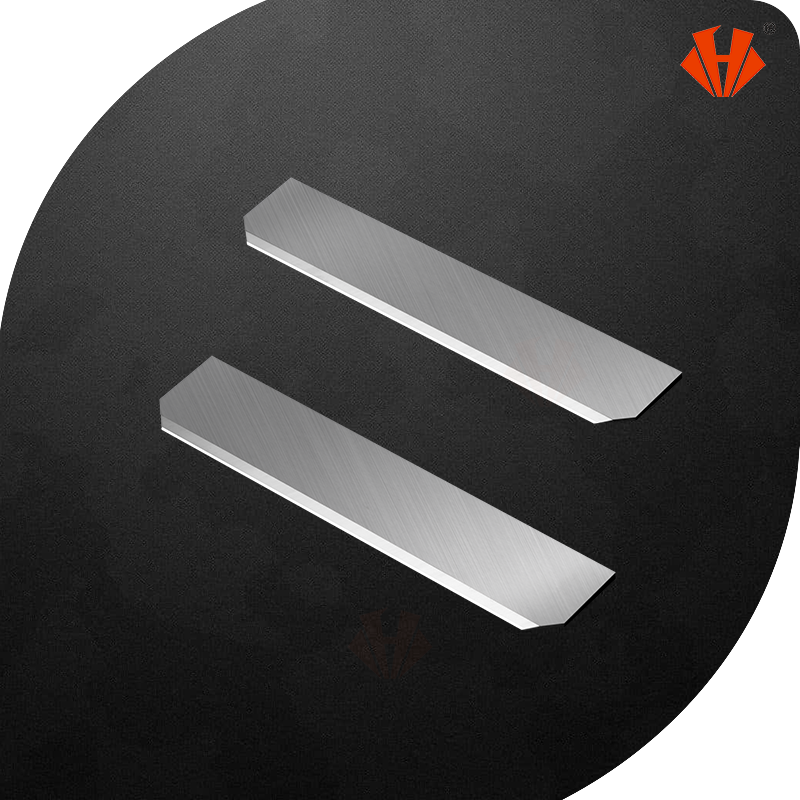
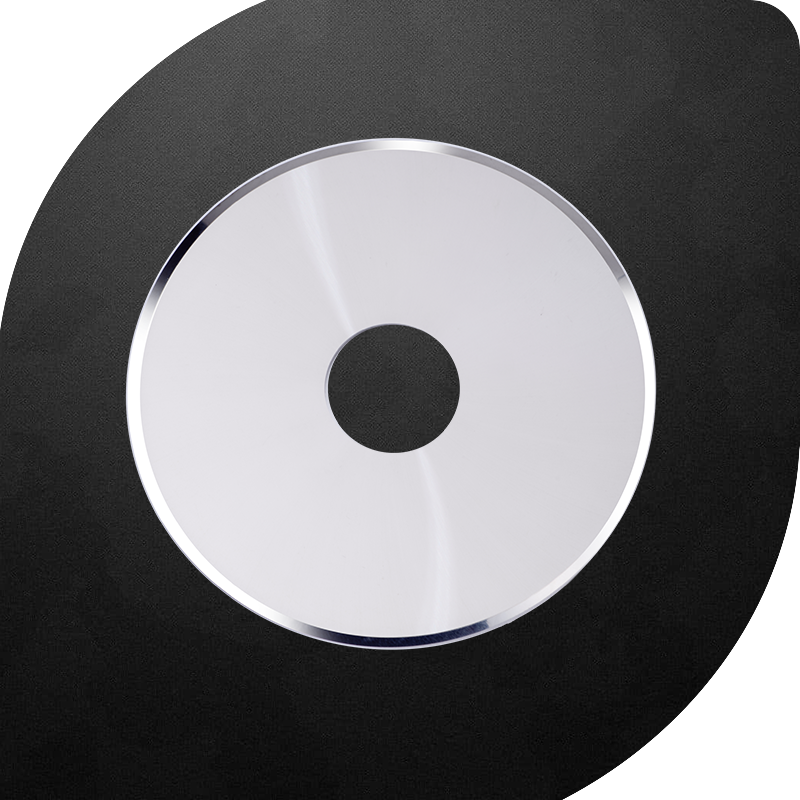
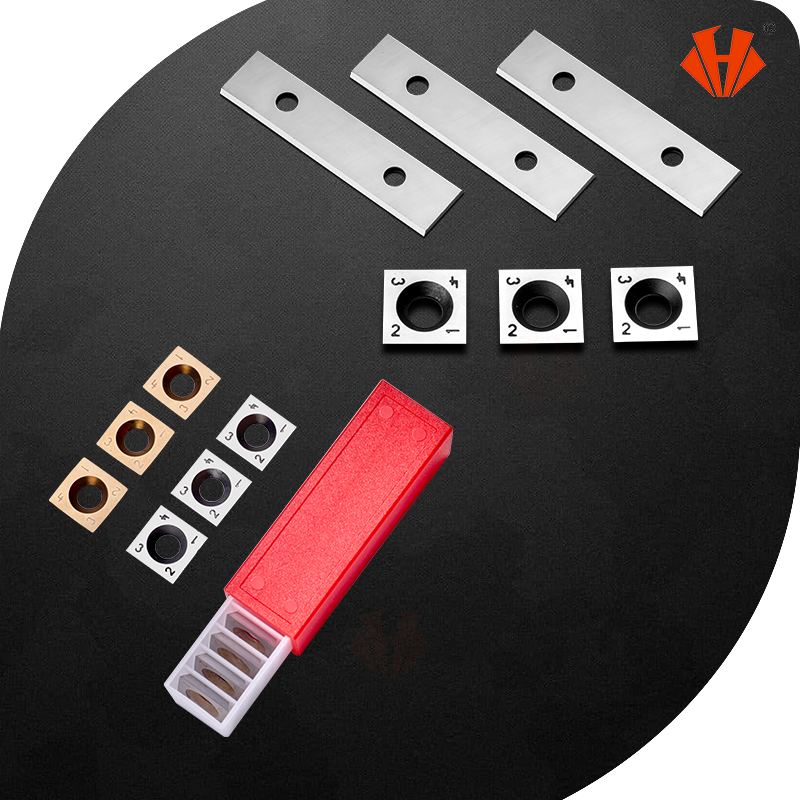
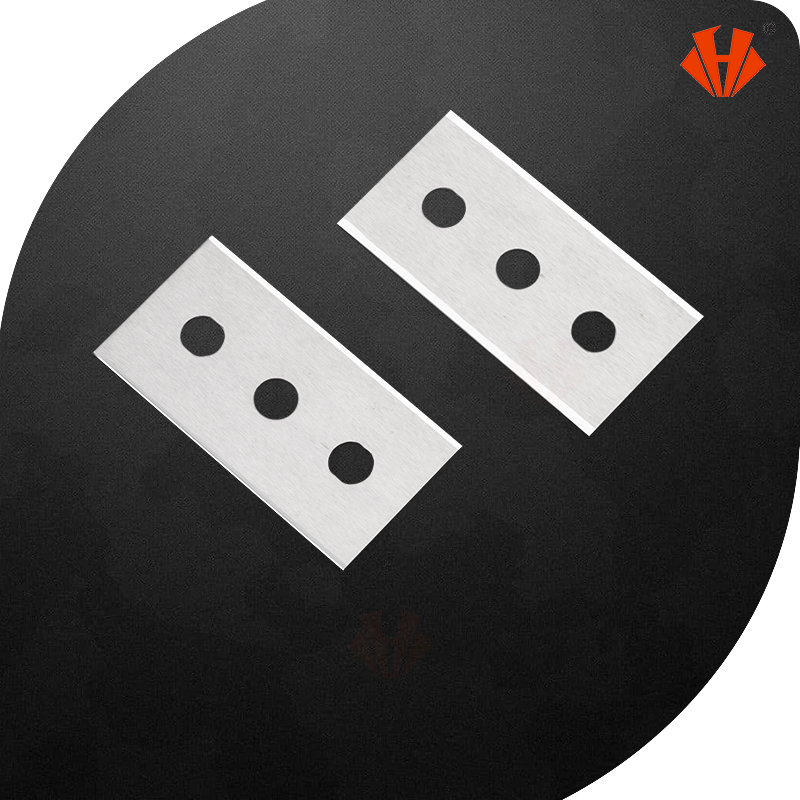
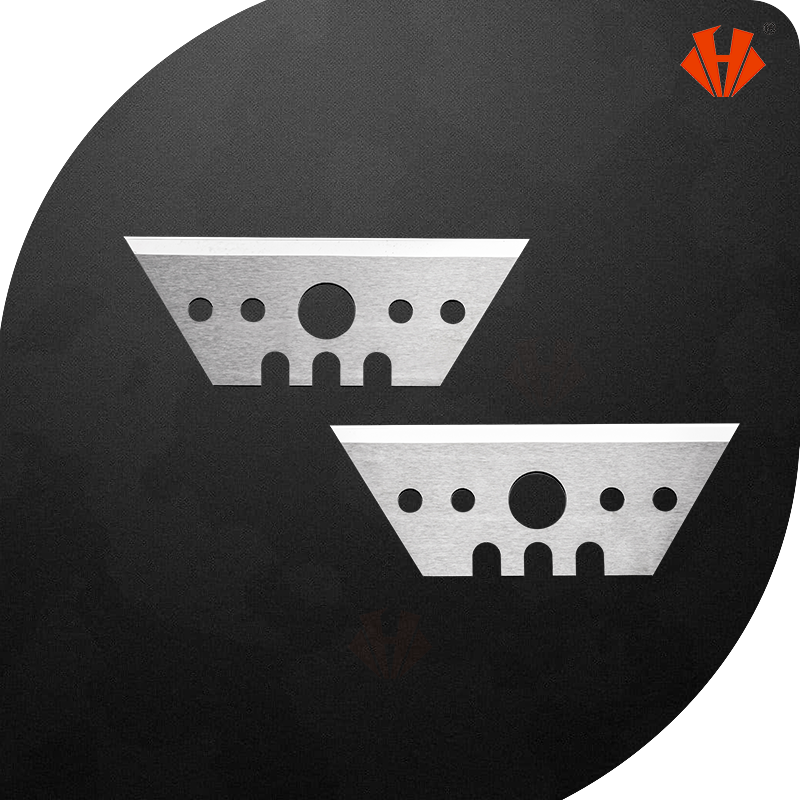
CHENGDU HUAXIN CEMENTED CARBIDE CO.,LTD are a professional supplier and manufacturer of tungsten carbide products, such as carbide insert knives for woodworking,carbide circular knives for tobacco&cigarette filter rods slitting,round knives for corugatted cardboard slitting ,three hole razor blades/slotted blades for packaging ,tape,thin film cutting,fiber cutter blades for textile industry etc.
With over 25 years development, our products have been exported to U. S. A, Russia, South America,India,Turkey,Pakistan,Australia,Southeast Asia etc. With excellent quality and competitive prices, Our hard working attitude and responsiveness are approved by our customers. And we would like to establish new business relationships with new customers.
Contact us today and you will enjoy benefits of good quality and services from our products!
The high performance tungsten carbide industrial blades products

Custom Service
Huaxin Cemented Carbide manufactures custom tungsten carbide blades, altered standard and standard blanks and preforms, starting from powder through finished ground blanks. Our comprehensive selection of grades and our manufacturing process consistently delivers high-performance, reliable near-net shaped tools that address specialized customer application challenges across diverse industries.
Tailored Solutions for Every Industry
custom-engineered blades
Leading manufacturer of industrial blades
Follow us: to get Huaxin's industrial blades products releases

Customer common questions and Huaxin answers
That depends on the quantity, generally 5-14days. As an industrial blades manufacturer, Huaxin Cement Carbide plans the production by orders and customers' requests.
Usually 3-6 weeks, if you request customized machine knives or industrial blades that are not in stock at the time of purchasing. Find Sollex Purchase & Delivery Conditions here.
if you request customized machine knives or industrial blades that are not in stock at the time of purchasing. Find Sollex Purchase & Delivery Conditions here.
Usually T/T, Western Union...deposits firstm, All first orders from new customers are prepaid. Further orders can be paid by invoice...contact us to know more
Yes, contact us, Industrial knives are available in a variety of forms, including top dished, bottom circular knives, serrated / toothed knives, circular perforating knives, straight knives, guillotine knives, pointed tip knives, rectangular razor blades, and trapezoidal blades.
To help you get the best blade, Huaxin Cement Carbide may give you several sample blades to test in production. For cutting and converting flexible materials like plastic film, foil, vinyl, paper, and others, we provide converting blades including slotted slitter blades and razor blades with three slots. Send us a query if you're interested in machine blades, and we'll provide you with an offer. Samples for custom-made knives are not available but you are most welcome to order the minimum order quantity.
There are many ways that will prolong the longevity and shelf life of your industrial knives and blades in stock. contact us to know about how proper packaging of machine knives, storage conditions, humidity and air temperature, and additional coatings will protect your knives and maintain their cutting performance.
Post time: Feb-02-2026


